Refrigerator Repair
Why the Garage Freezer Dies First in Maryvale: Canopy, Night Heat and Refrigeration Duty Cycle
The garage freezer fails before the kitchen unit because a low-canopy block never cools down at night, so the compressor runs a near-continuous duty cycle all summer. What Phoenix tree-cover inequality does to refrigeration in Maryvale, Coronado, Roosevelt Row and Sunnyslope.
- Written by
- Warren Ibarra
- Trade
- Refrigeration technician — condenser and heat-load work · 20 years in the trade
What Phoenix actually does differently
Phoenix does not have one summer. It has as many summers as it has streets. Tree canopy across the metro averages under ten percent, but it is spread very unevenly: some older, wealthier neighbourhoods approach thirty percent, while many of the poorest sit under five. Maryvale is named specifically among the places that run hotter, in part for lack of tree cover.
The number that reaches your appliances is not the afternoon high — it is the overnight low. Reporting on canopy equity here has put night-time temperatures in low-canopy neighbourhoods as much as twenty-two degrees warmer than areas outside them. Modelling from ASU found that lifting canopy from about ten percent to twenty-five percent would cool a typical Phoenix neighbourhood by roughly 4.3 degrees Fahrenheit, which is the target the city’s Tree and Shade Master Plan is aimed at. Pavement, block walls and roofs charge up all day and give it back all night, and on a five-percent-canopy block there is nothing shading any of it.
That is the whole mechanism. Everything below follows from a garage that never gets cold again until October.
How that reaches the appliance
Refrigeration does not make cold. It moves heat out of a cabinet and rejects it into the air of the room the unit stands in, and how well it can do that depends entirely on the temperature difference between the condenser and that air. Shrink the difference and the machine has to run longer to move the same heat. Shrink it enough and it never catches up.
A kitchen unit is protected by the air conditioning. The overflow freezer and the second refrigerator are not. They live in the garage, the service porch or a utility alcove, and in a low-canopy block those spaces are still holding the day’s heat at four in the morning. So the compressor that would normally cycle off for a good part of the night simply does not. It accumulates run hours at a rate the same model would never see in a shaded, conditioned space, and it fails on hours rather than on a defect.
The pattern is different in each of the neighbourhoods we cover. In Maryvale, the fifties block-built ranch tracts almost always have the second unit in an attached garage on the sun side. In Coronado, the bungalow kitchens were added at the back and there is often a casita behind, which puts a unit in a small outbuilding with poor cross-ventilation. In Roosevelt Row, undercounter and panel-ready columns get wedged into tight galley cabinetry in converted warehouse space, where the constraint is not sun but the absence of any clearance to breathe. Sunnyslope puts wine storage and patio-side refrigeration in shade structures that shade the person, not the machine.
What tends to give first
The condenser fan motor goes first, more often than anything else. It is the component running whenever the compressor runs, and in a high-duty-cycle installation it simply accumulates the hours first. Bearings dry out, the blade goes slightly out of balance, airflow across the fin pack drops, and the whole system slides further out of its comfortable range.
Next is the door gasket. Heat and repeated open-close cycles take the elasticity out of the seal, it takes a permanent set, and the door stops pulling itself shut against it. That leaks warm humid air into a cabinet that is already struggling, which loads the evaporator with frost, which starves airflow and puts water under the crisper drawers.
Then the evaporator fan and the defrost circuit, both of which get worked harder by the extra moisture. The compressor and sealed system come later — and this is the point worth holding on to, because in a garage installation the compressor is usually the victim of the environment rather than the cause of the complaint.
What you can check yourself
Measure the space rather than eyeballing it. A built-in needs its specified clearance at the toe grille and above, and a unit pushed tight into cabinetry or backed against a hot west-facing wall is being asked to reject heat into its own exhaust.
Pull the grille and look at the fin pack. In a garage it collects lint, drywall dust and yard debris far faster than a kitchen unit does, and a matted fin pack is what we turn up more often than any other single finding out here.
Trap a strip of paper in the door and tug. Little or no resistance means the gasket has lost its set and is no longer sealing. Watch whether the door pulls itself closed from a few inches open, and look for condensation along the frame.
Then think about siting. Shading the wall the unit stands against, keeping the garage door habits sensible in July, and giving the machine real clearance on the exhaust side does more for its remaining lifespan than any part we could sell you.
What a visit settles
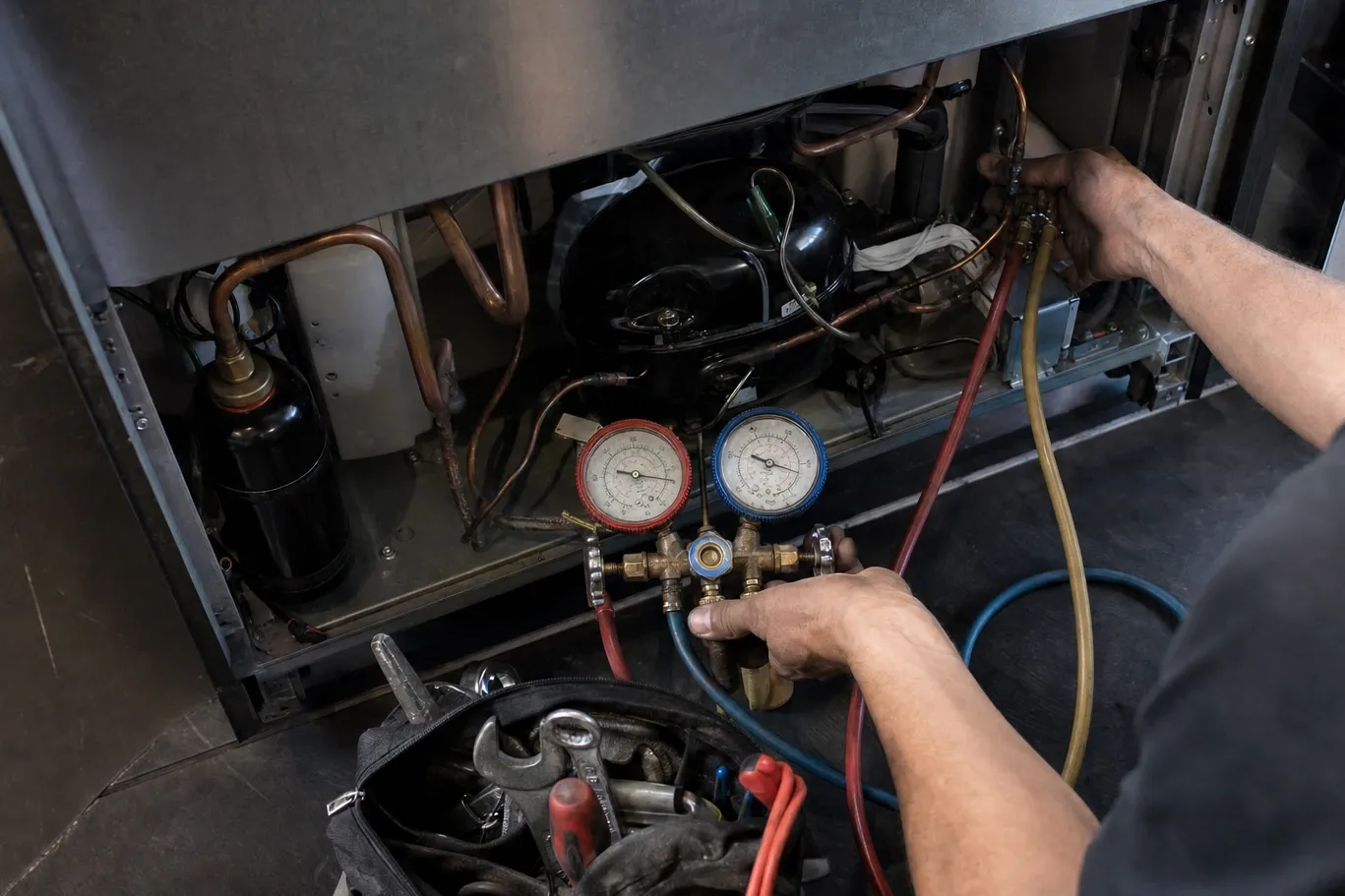
A visit settles whether you have a failed part, a fouled coil, or a machine that is simply installed somewhere it cannot survive — and those three have very different answers. We take real cabinet temperatures rather than reading the display, measure compressor run time and current draw, read the condenser and the fan, check gasket and door closure, and only then look at boards and sensors.
Costs, where parts turn out to be involved. Fan motor work — evaporator or condenser — falls between $340 and $720, and it is the band this neighbourhood hits most. A door gasket or seal replacement is $280 to $670. Defrost heater, thermostat or sensor work sits at $280 to $630, while an ice maker, water valve or supply line runs $270 to $820. An electronic control board is $430 to $920. Compressor and sealed-system repair, at $1,330 to $3,180, is the band that decides whether a garage unit is worth keeping.
The trip and the diagnosis together are $89. Dial (623) 469-9119, or book through the link on this page, and mention whether the unit lives in the house or the garage — that one detail changes what we expect before we arrive.
Follow-up questions
Why does my garage freezer struggle every summer when the kitchen unit is fine?
Because the kitchen unit rejects its heat into conditioned air and the garage unit does not. On a low-canopy block the garage is still warm overnight, so the compressor never gets the rest period it would normally take between about midnight and dawn. It runs an almost continuous duty cycle for months. That is an environment problem first, which is why the fix usually starts with clearance, coil cleaning and shade rather than with a part.
Does cleaning the condenser coil really make a difference in Phoenix?
More here than almost anywhere. The coil is how the machine gets rid of heat, and it is already fighting a smaller temperature difference than the same unit would have in a cooler climate. A fin pack matted with garage lint removes what little margin is left. We clear it front to back and clean the fan blade, and on a lot of first visits the running temperature drops without a single part being replaced.
Is it worth moving the second refrigerator out of the garage in Maryvale?
If there is anywhere sensible to put it, yes. Anything that gives the unit cooler air to reject heat into buys back run hours directly. Where moving it is not realistic, the next best steps are real clearance around the grille and exhaust, shade on the wall it stands against, and keeping the coil clean. Those are the levers, and they cost far less than the $1,330 to $3,180 sealed-system band.