Refrigerator Repair
Fresh food side warm, freezer still cold: what it means on a Sub-Zero
On a built-in Sub-Zero, a warm refrigerator with a cold freezer is almost never lost refrigerant. It is airflow, defrost, or one half of a dual-refrigeration cabinet — and in Phoenix it is usually the condenser.
- Written by
- Warren Ibarra
- Trade
- Refrigeration technician — condenser and heat-load work · 20 years in the trade
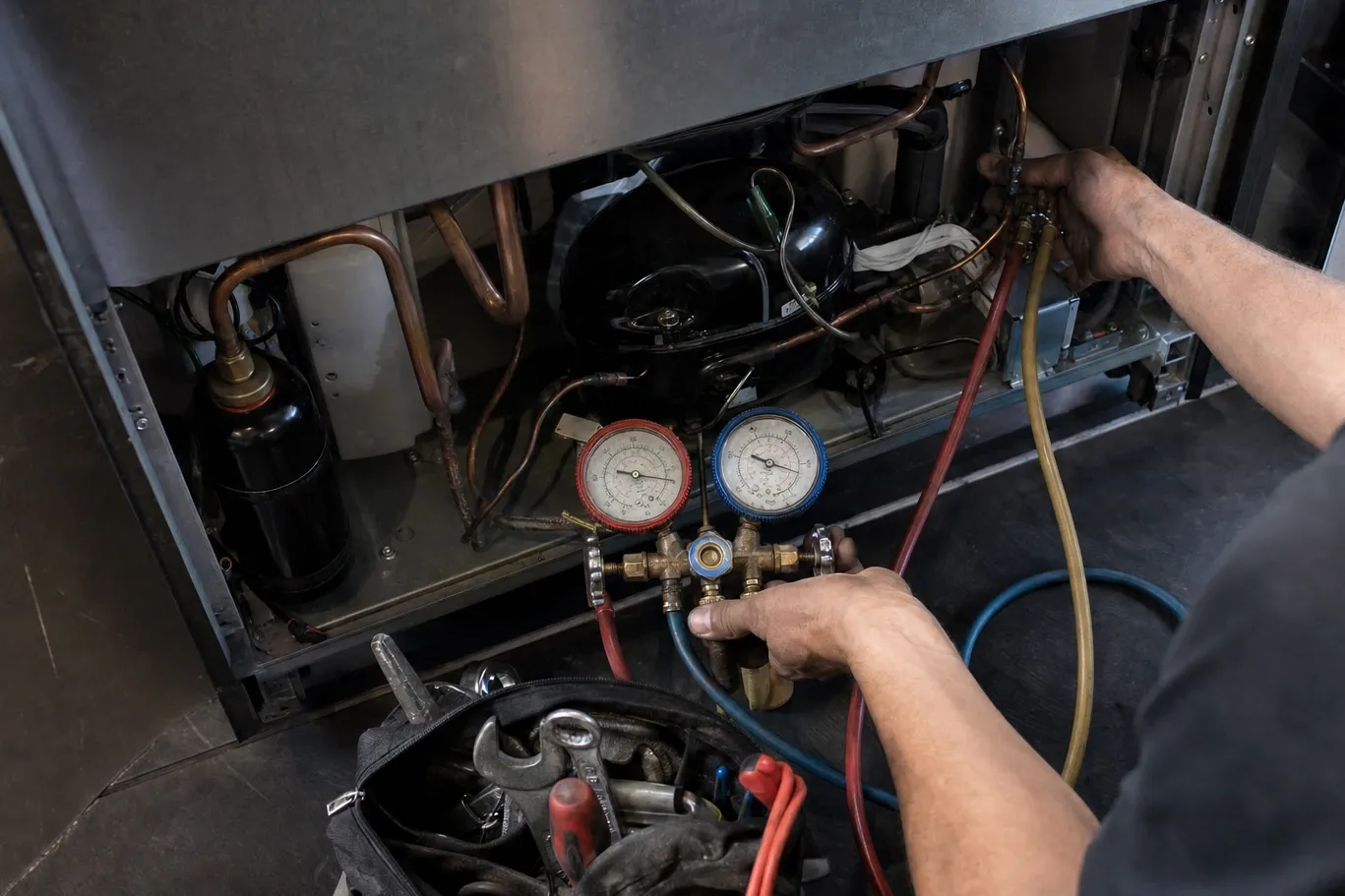
A Sub-Zero that has gone warm on the fresh food side while the freezer is still making hard ice is telling you something quite specific, and it is rarely the thing people fear. Refrigerant loss takes both compartments with it on a single-system cabinet, and on a dual-refrigeration cabinet it takes one side down completely rather than leaving it lukewarm. A cold freezer plus a warm refrigerator is a story about air, ice and sensors — and in a Phoenix kitchen in July, it is a story about heat rejection more often than anything else.
Here is the order we work through it in, and how far you can reasonably get before the panels come off.
Start with the condenser, because this is Phoenix
Every built-in Sub-Zero rejects its heat through a condenser coil behind the lower grille or, on some columns, up at the top. That coil is a fine aluminium comb, and it is a magnet for dust, pet hair and the grit that blows in off the desert. In a 70°F room a matted coil is a nuisance. In a kitchen sitting at 82°F with afternoon sun on the wall, it is the difference between a unit that holds temperature and one that runs continuously and still loses ground from three o’clock onwards.
The tell is a compressor that never rests. Put your hand near the grille: if the air coming out is hot and the fan is loud but the fresh food compartment is climbing anyway, airflow is the first suspect. Pull the grille, look at the fins with a torch, and if you cannot see daylight through them, that is your fault found. Vacuum along the fins, not across them, and clear the fan blades — they cake up in a way that is easy to miss because the motor still spins.
Two things make this worse in older west-side and downtown installations: a decorative plinth or panel that the cabinetmaker added over the intake after the unit went in, and a run of cabinetry with no clearance above the top vent. Both turn a working unit into one that recirculates its own hot air.
Then airflow inside the cabinet
On a single-system Sub-Zero, the freezer is where the cold is made and the refrigerator is cooled by air ducted across from it. Anything that interrupts that duct gives you exactly this symptom: perfect freezer, warm fridge.
- Evaporator fan. If the fan behind the freezer’s rear panel has seized or is running slow, cold air stops moving. Hold the freezer door switch closed and listen: you should hear the fan spin up within a few seconds.
- A frosted evaporator. Frost sheeting the coil blocks air before it blocks cooling. The freezer stays cold because it is sitting next to a block of ice; the refrigerator gets nothing.
- The duct itself. A box of food pushed hard against the rear air outlet, or an ice build-up in the duct after a defrost problem, will starve one compartment while the other is fine.
Defrost, the fault that hides behind a good-looking freezer
The defrost circuit is the most common real failure on this equipment, and it is sneaky: for weeks the freezer looks better than ever while frost builds where you cannot see it. A failed defrost heater, an open terminator or a control that has stopped calling for defrost all end the same way — a coil packed in ice, no air movement, and a refrigerator compartment that slowly gives up.
You can often see the evidence without tools. Look for ice on the rear wall of the freezer rather than neat frost on the food, water tracking down the back, or a basket that has frozen into place. If the drain has frozen as well, you will get sheets of ice under the bottom basket that come back a week after you chip them out.
Dual refrigeration changes the whole question
If the model is a dual-refrigeration cabinet — most 600, 700 and BI series built-ins — the two compartments have separate sealed systems, separate evaporators and, in many cases, separate compressors. Airflow between the compartments is not how it works, so the reasoning above does not apply in the same way.
On these, a warm refrigerator with a cold freezer means the refrigerator’s own system has a fault of its own: a charge loss, a restriction in the capillary or filter-drier, a failed compressor, or a control that is not calling for cooling on that side. This is the point where an honest answer needs gauges. A temperature reading cannot tell a slow leak from a restriction, and the repair for each is completely different.
Model numbers live inside the fresh food door on the upper left frame. It is worth writing yours down before you ring anyone, because it decides which of these two conversations you are having.
What to check before you call, and when to stop
Work through this list in order. It takes fifteen minutes and it either fixes the problem or tells us where to start.
- Read the actual temperature with an independent thermometer on the middle shelf, left for four hours. Do not trust the panel on its own.
- Pull the lower grille and look at the condenser. Clean it if it is furred.
- Check nothing is blocking the intake or the top vent — plinths, panels, baskets, boxes.
- Hold the freezer door switch and listen for the evaporator fan.
- Look at the freezer’s rear wall for ice, and under the bottom basket for water or a frozen drain.
- Check the door pulls itself shut and the gasket makes contact all the way round. Dry desert air hardens gaskets, and a heavy panel-ready door drops on its hinge over the years.
Stop at the point where the answer needs pressures. If the coil is clean, the fans run, there is no ice on the evaporator and the compartment still will not come down, the next step is a manifold set on the service valves — and on a foamed-in evaporator that measurement is also what decides whether the cabinet is worth repairing at all. That is a call worth paying $89 to have answered properly rather than guessing at over a weekend of warm food.
Follow-up questions
Can I keep using the freezer while the refrigerator side is warm?
Usually yes, and on a dual-refrigeration cabinet it is completely independent. On a single-system model the freezer is doing the work for both compartments, so it will run harder than normal — expect more frost and a longer defrost recovery until the fault is fixed.
How warm is too warm before I move the food?
Above 40°F the clock starts. If the fresh food compartment has been sitting in the mid-forties or higher for four hours or more, move anything perishable to a cooler rather than waiting for a visit.
Is it worth cleaning the condenser myself?
Yes. Pull the lower grille, vacuum the fins gently in the direction they run and clear the fan housing of lint. It is the single most useful thing an owner can do on this equipment in Phoenix, and it fixes a real share of warm-refrigerator calls outright.
The panel shows the right temperature but the shelf feels warm. Which do I trust?
Neither, until something independent agrees. Put a glass of water with a kitchen thermometer in it on the middle shelf and read it after four hours. A drifted thermistor makes the display confidently wrong, and it is a common fault on cabinets that are ten years and older.